Category: News

  • Scratched Glass Cooktops Can Look New Again Without Costly Replacement

    Scratched Glass Cooktops Can Look New Again Without Costly Replacement

    The first time you see it, your heart drops. The once flawless, black glass cooktop now has a pale, uneven scratch stretching across the surface. It may have happened while sliding a heavy pot or when a tiny grain of salt slipped under a pan. The mark feels small, yet it catches your eye every time you walk into the kitchen. Running your fingers over it reveals a rough edge, triggering concern that the damage is permanent and leaving you wondering whether replacement is inevitable.

    Why Glass Cooktops Scratch Even With Careful Use

    Glass cooktops appear sleek, durable, and almost indestructible, but the surface is more delicate than it looks. Everyday actions like moving cookware, using a cast-iron pan with a coarse base, or cooking over unnoticed debris can quietly leave marks behind. These scratches often remain invisible at first and only become obvious during cleaning. The good news is that many surface scratches are cosmetic and can often be reduced with the right, gentle approach.

    Assessing the Scratch Before You Start

    Before attempting any repair, take a moment to evaluate the scratch under bright, direct light and from multiple angles. If it only appears at certain angles and your fingernail glides smoothly over it, the mark is likely shallow. If your nail catches slightly, it may still be treatable at home. Deep grooves that clearly snag your nail are more serious and cannot be fully removed without professional help. Thinking in terms of light haze, visible lines, and deep grooves helps set realistic expectations.

    Choosing the Right Tools for Safe Polishing

    Always begin by cleaning the cooktop thoroughly to remove grease and residue. Use a cooktop-safe cleaner and a soft cloth, then dry the surface completely. When polishing, stick to mild solutions such as baking soda paste, non-gel toothpaste, ceramic cooktop cream, or glass polishing compound. These options work by gently smoothing the surface rather than aggressively wearing it down. Avoid steel wool, abrasive pads, or gritty cleaners that can cause additional damage.

    Effective At-Home Methods to Reduce Scratches

    Test any method on a small, less visible area first. For light scratches, gently rub baking soda paste or toothpaste in small circular motions using a microfiber cloth. Wipe the area clean, inspect the results, and repeat if necessary. For more noticeable marks, ceramic cooktop cream or a glass polishing compound may offer better results. Apply with light pressure and patience. While deep scratches will not vanish, careful polishing can significantly soften their appearance.

    Restoring Shine After Polishing

    Once the scratch looks less visible, clean the surface again to remove any remaining residue. Many people finish with a glass cooktop cleaner that leaves a subtle protective shine. Buff gently with a dry microfiber cloth until the surface reflects evenly. The scratch may still exist faintly, but it usually blends into the background rather than standing out.

    Common Polishing Options and Their Uses

    • Baking soda paste works best for minor surface marks and dull patches but is ineffective on deeper scratches.
    • Non-gel toothpaste helps with light, visible scratches, though multiple applications may be needed.
    • Ceramic cooktop polishing cream is designed for light to moderate damage and safely restores shine.
    • Glass polishing compound offers stronger results for stubborn scratches but requires careful use.

    Preventing Future Scratches on Glass Cooktops

    Preventing scratches often comes down to small habit changes. Lift cookware instead of sliding it, clean the bottoms of pots and pans before use, and wipe away spills like sugar or salt before reheating. Avoid placing heavy or rough cookware directly on the cooktop. If you use protective covers, ensure they are heat-safe and designed for glass surfaces.

    When Replacement Becomes the Safer Option

    If a mark begins to resemble a crack, spreads over time, or feels deeply gouged, it’s best to stop home repairs and seek professional guidance. Structural damage can affect how the glass handles heat and may pose a safety risk. However, most everyday scratches are purely cosmetic. With gentle care and patience, many cooktops can maintain a smooth, attractive appearance for years.

    Maintaining Confidence With Your Glass Cooktop

    A glass cooktop naturally reflects signs of daily use over time. Scratches do not always signal neglect or failure; they are often part of regular cooking life. Learning how to reduce their appearance helps keep your kitchen looking calm and well cared for. More importantly, it builds confidence in maintaining your appliance without unnecessary worry, allowing you to focus on cooking comfortably and confidently.

  • Study Reveals Parenting Attitudes That Often Lead to Childhood Unhappiness

    Study Reveals Parenting Attitudes That Often Lead to Childhood Unhappiness

    Imagine a toddler negotiating for one more cookie. A dad scrolling through emails with one hand while bouncing a baby with the other. In the background, a 9-year-old is frozen in front of a tablet, her mother whispering, “Stop crying, you’re fine,” through clenched teeth. Modern parenting looks nothing like it did 30 years ago, yet the pressure to “get it right” has never been heavier. We read studies at midnight, follow parenting influencers, and share infographics about emotional security. Then, we lose our patience over a missing shoe before school. Psychologists are quietly agreeing on something troubling. Certain well-intentioned parenting attitudes are consistently linked with anxious, withdrawn, or chronically unhappy kids. The twist? Many of these attitudes are praised as “good parenting” in everyday life.

    What if the very things we do to protect our children are the ones stealing their joy?

    1. The “Perfect Childhood” Obsession

    Everywhere you look, childhood is sold like a product. Curated bedrooms, enriching activities, organic snacks, emotionally intelligent conversations on demand. Many parents carry a quiet belief: if I create the perfect environment, my child will be happy.

    This attitude sounds loving. It often comes from wanting to give our kids what we never had. Still, it turns parenthood into a never‑ending performance. Kids, sharper than we think, sense the invisible script. They feel they must also perform: be grateful, be delighted, be advanced, be “thriving”.

    Inside, some of them are just… tired.

    In one UK survey, over 60% of parents said they feel pressure to “maximise” their child’s potential through constant stimulation. Picture a 7-year-old whose week is a spreadsheet: violin, languages, sports, playdates, mindfulness apps.

    On paper, this looks like opportunity. In reality, lots of kids live with a subtle background fear: If I’m not shining, I’m disappointing everyone. A mother I interviewed described her son’s reaction when she cancelled one activity: he cried with relief and whispered, “Can I just go home and be boring?”

    The pursuit of the perfect childhood had quietly turned into a full-time job for both of them.

    Psychologists warn that children raised in an “optimised” childhood bubble often struggle with boredom, frustration, and ordinary imperfection. Everything is pre-selected, pre-screened, pre-approved. Life feels safe yet strangely narrow.

    When things go wrong — a lost game, a bad grade, a friend who stops answering messages — they haven’t had much practice in recovering. Happiness, in their experience, lives only where conditions are ideal.

    So any crack in the perfection feels like a personal failure, not just a bad day.

    2. The “Never Feel Bad” Mindset

    There’s a new ideal floating around: the always‑regulated, endlessly calm child. Parents repeat soothing scripts, redirect “negative” emotions, talk about positivity and gratitude. Underneath lies a quiet rule: sadness, anger, jealousy are problems to fix fast.

    When a child cries, we rush to distract: “Look, a bird!” When they’re angry, we explain why they shouldn’t be. When they’re scared, we say, “There’s nothing to be afraid of.” It sounds gentle. It can feel caring.

    To a child, though, the message can land as: your feelings are wrong here.

    Take Lea, 10, who started complaining of stomach aches before school. Her parents, worried, reminded her how “lucky” she was — nice teachers, good friends, safe environment. They told her to think positive, to focus on the good things. Her symptoms got worse.

    A school counselor finally asked her, “What’s the worst part of your mornings?” Lea whispered, “I’m scared to say I’m scared, because everyone tells me I shouldn’t be.” Her anxiety wasn’t just about school; it was about being alone with feelings nobody wanted to see.

    Research on emotional validation is blunt. Kids who are consistently told to “cheer up”, “calm down”, or “stop overreacting” learn to doubt their own inner world. They don’t stop feeling bad; they just stop talking about it.

    This silence often shows up later as mood swings, explosive anger, or a flat, numb kind of unhappiness that looks like apathy. The child’s real experience stays underground, growing in the dark.

    3. The “Always Be Productive” Script

    Ask a modern child to describe a “good” day and you might hear: “I finished my homework, my practice went well, I got my reading minutes done.” Productivity has quietly replaced play as the moral compass of childhood.

    Parents rarely say, “Your worth is your output,” yet many act as if idle time is suspicious. Weekends are filled with “enriching” tasks, evenings sliced into chunks of performance. Even rest becomes strategic: “Recharge so you can do more tomorrow.”

    Kids learn to measure themselves by what they’ve done, not how they’ve lived.

    In one longitudinal study on over-scheduled kids, researchers found a strong link between constant performance pressure and symptoms of depression by early adolescence. One 13-year-old girl summarised it better than any scientist: “I don’t know how to just exist without proving something.”

    She wasn’t failing. She was at the top of her class, star of her team, teacher’s favourite. At home, every good result was celebrated, every slip analysed. Her parents were proud, thoughtful, deeply involved.

    They had accidentally taught her that rest, joy, and silliness were optional extras — only allowed once the “real” work of childhood was done.

    Psychologically, chronic productivity focus does something sneaky. It hijacks motivation from the inside. Activities stop being fun in themselves; they become tools to earn praise, avoid criticism, or chase a future CV.

    Kids raised in this atmosphere often report a low-grade emptiness. Even when they achieve, the satisfaction doesn’t stick. There’s always the next test, the next level, the next comparison. Happiness gets postponed to an imaginary later that never quite arrives.

    4. The “My Child Is My Project” Trap

    One of the most subtle attitudes is this: seeing your child as a reflection of you. Not in a poetic, genetic way, but as a living résumé. Their table manners, grades, friends, and hobbies become a kind of public performance of your own worth.

    This is the parent who winces when their child melts down at a birthday party, not for the child’s distress, but for how it looks. The parent who steers interests — sports, music, language — toward what “makes sense” socially or professionally.

    On the surface, it’s involvement. Underneath, the child feels less like a person and more like a brand.

    On a school playground in Paris, a father proudly listed his daughter’s achievements, barely pausing for breath: bilingual, piano, competition maths. When she wandered over, looking bored, he frowned. “Tell them about your medal.” She shrugged.

    Later, away from him, she told another girl, “My dad likes my life more than I do.” It wasn’t cruelty. It was clarity.

    Psychology has a name for this dynamic: enmeshment. Boundaries blur. The parent’s self-esteem rises and falls with the child’s successes and failures. It creates an invisible weight: the child feels responsible not only for their own life but for their parent’s emotional stability.

    That weight is heavy for a small set of shoulders.

    Children in this setup often become experts at scanning adult moods. They choose subjects, friends, and futures that keep the peace rather than light them up. They may look “well-adjusted” from the outside, yet inside they wrestle with a quiet question: Who am I when I’m not pleasing anyone?

    Unhappiness here doesn’t always look dramatic. It can show up as flatness, lack of curiosity, or living life on mute.

    5. From Pressure to Presence: What Helps Kids Actually Feel Happy

    The most powerful shift parents describe is surprisingly simple: trading control for connection. Instead of asking, “How do I fix my child’s behaviour?” they start with, “What’s it like to be them right now?”

    Small, repeatable gestures make a bigger difference than major parenting overhauls. One mother began a five-minute ritual before bed: “Tell me one good thing, one hard thing.” No advice, no lecture. Just listening.

    Within weeks, her 11-year-old, who had been silent about school, began sharing playground dramas and secret fears. Nothing in their schedule changed. The emotional climate did.

    Kids thrive when they feel seen, not managed.

    6. A Different Kind of Ambition for Our Kids

    Modern parenting is happening in loud times. Algorithms, experts, relatives, teachers — everyone has an opinion about what a “successful” child looks like. It’s tempting to translate that straight into how a “successful” parent should act.

    The research on happiness in children points somewhere quieter. Kids don’t need flawless parents, constant entertainment, or perfectly regulated emotions. They need room to feel, to fail, to grow at their own weird, asymmetric pace, under the gaze of adults who don’t flinch when things get messy.

    On a park bench, a mother watched her son climb a tree higher than she liked. She stood up, sat down, stood again. Finally she called out, “I’m scared, but I trust you. If you fall, I’m here.” He grinned, climbed one branch higher, then carefully came back down.

    That’s the strange balance modern kids seem to crave: freedom with a net, not a cage.

    We’ve all lived that moment where a child looks at us with wet eyes, searching our face to understand if their feelings are allowed. Our reaction, more than our rules or routines, shapes their private sense of the world. Is this a place where I must perform, or a place where I can be fully alive — thrilled, furious, bored, overwhelmed, delighted?

    Happiness, in the psychological sense, isn’t about constant smiles. It’s about feeling that your inner life belongs to you and is welcome in your closest relationships. When parents dare to trade some control for curiosity, some pressure for presence, kids often don’t become less ambitious.

    They become freer. And that freedom — to be who they are, not just who we hoped they’d be — may be the one childhood gift that keeps unfolding for the rest of their lives.


  • Hair Loss Reduction Linked to Home Remedies That Strengthen Roots and Improve Hair Condition

    Hair Loss Reduction Linked to Home Remedies That Strengthen Roots and Improve Hair Condition

    The moment you see more hair than usual on your pillow or in the shower drain triggers something in your mind. You find yourself running your fingers through your hair and wondering when it started to thin out. This creates an internal worry that you can keep hidden from others but you cannot ignore it yourself. You might convince yourself that stress is the cause or blame it on seasonal changes. Maybe you switched to a different shampoo or wore your hair in a tight style. These reasons seem easier to accept than facing the possibility of a real problem.

    Understanding the Subtle Messages Your Hair Shares

    Your hair shows what happens in your daily life and how balanced you feel inside. When you stay up late or skip meals or rush through showers or pull your hair too tight or use harsh products or deal with constant stress, your hair remembers all of it. Hormones shift and seasons change and you get older & these things affect your hair too. Your body usually tries to tell you something is wrong long before you notice hair falling out. It asks for rest & better food and gentler treatment. But when life gets busy these warnings are easy to miss. Coloring your hair often and using hot tools and washing it too much can push it past what it can handle. When you see more hair falling out you want a fast fix. But there is a better way that takes more time. Home remedies work with your body instead of trying to force it to change.

    Oil Rituals That Nourish Hair from Root to Tip

    Hair oiling is a traditional practice focused on nourishment and wellness. Warming oil between your palms and working it into your scalp does more than make hair softer. It helps you relax and improves blood flow to the scalp. Coconut oil prevents protein loss and protects hair that tends to be dry. Castor oil works well for keeping the scalp moisturized when used in small amounts. Almond oil sesame oil and olive oil each bring their own benefits for conditioning hair. Different oils work better for different people and mixing oils often gives the best results. Regular oiling paired with gentle scalp massage nourishes the scalp and makes hair roots stronger while bringing a sense of peace to hectic routines.

    Scalp Massage: A Simple Yet Powerful Practice

    Massaging your scalp matters just as much as the oil you use. When you move your fingertips slowly in circles you boost blood flow & help nutrients get to your hair follicles. Start at your hairline & work your way back to wake up the skin under your hair. Spending just five to ten minutes a few times each week can make a real difference. Apart from the physical benefits scalp massage also reduces stress and releases tension that might be causing your hair to fall out over time.

    Herbal Oils and Homemade Infusions

    You can make your own herbal hair oils at home for a more thoughtful hair care routine. Common ingredients include rosemary curry leaves, hibiscus & fenugreek. The process involves gently heating these herbs in oil and letting them soak to release their beneficial compounds. Rosemary helps boost blood flow to the scalp while hibiscus and fenugreek work to condition hair and make it stronger. Taking time to prepare your own oil creates a custom blend that feels both calming and deeply nutritious for your hair.

    Everyday Kitchen Remedies with Lasting Benefits

    Natural Hair Care from Your Kitchen Your kitchen already contains many effective hair treatments. Common ingredients such as seeds, yogurt, eggs & aloe can help keep your scalp healthy and prevent hair breakage. While these natural remedies work gradually rather than overnight they promote regular care habits & thoughtful attention to your hair’s needs. Making these treatments yourself transforms hair care into a form of self-care. This hands-on approach demonstrates that healthy hair doesn’t require expensive store-bought products. The simple act of preparing natural treatments reminds us that real nourishment often comes from basic wholesome ingredients we already have at home.

    nourishment does not always come from packaged products.

    Natural Hair Care from Your Kitchen Your kitchen already contains many effective hair treatments. Common ingredients such as seeds, yogurt eggs and aloe can help keep your scalp healthy and prevent hair breakage. While these natural remedies take time to show results, they promote regular care habits and thoughtful attention to your hair’s needs. Making these treatments yourself transforms hair care into a form of self-care. This hands-on approach demonstrates that healthy hair doesn’t require expensive store-bought products. The simple act of preparing natural treatments reminds us that good nourishment often comes from basic ingredients we already have at home.

    Fenugreek: Tiny Seeds with Reliable Support

    Fenugreek seeds work well when you soak them overnight and blend them into a smooth paste for your scalp. These seeds contain proteins & helpful compounds that many people use to reduce hair loss and make their hair feel better. You can apply this paste once or twice each week for short periods to help your hair become thicker & stronger. Remember to use it in moderation & pay attention to how your scalp reacts since everyone’s skin is different.

    Aloe Vera: Soothing Balance for the Scalp

    Aloe vera offers cooling relief for irritated or oily scalps. The gel works to reduce inflammation and balance oil production while clearing away buildup that can clog hair follicles. When you apply it directly to your scalp and leave it on for twenty to thirty minutes aloe creates better conditions for healthy hair growth. You can also mix it with oils or yogurt to boost its nourishing effects.

    Protein Masks Made from Simple Foods

    Hair that gets exposed to heat or sunlight often needs extra protein support. Masks made with egg & plain yogurt can temporarily strengthen the hair shaft. This helps improve smoothness and reduces breakage. You should apply these masks to damp hair and rinse them out with cool water. It works best when you use them occasionally because this gives your hair strength without overdoing it.

    Food, Stress, and the Deeper Roots of Hair Health

    Hair health reflects your general physical state. When you lack important nutrients or deal with constant stress and hormone shifts or don’t sleep enough, your hair often shows these problems first through extra shedding or becoming thinner. Taking care of your scalp from the outside helps but what happens inside your body matters just as much. Eating enough protein along with iron and zinc and good fats gives your hair what it needs to grow strong. Drinking plenty of water and paying attention to what you eat keeps your hair healthy over time.

    The Hidden Role of Stress in Hair Fall

    Stressful periods or illness can trigger delayed hair shedding, where hair enters a resting phase before falling out months later. Managing stress through gentle movement, breathing practices, rest, and reduced screen time supports natural recovery. As stress hormones settle, hair growth cycles can gradually regain balance.

    Daily Habits That Preserve Hair Strength

    Daily habits determine how healthy your hair stays. Pick gentle shampoos and wash your hair only when needed. When you do wash it concentrate the shampoo on your scalp to keep natural oils intact. Apply conditioner from mid-length to the ends to minimize friction & prevent breakage. Try to use heat styling tools sparingly. Wear your hair in relaxed styles instead of tight ones. Switch to a silk or satin pillowcase at night to reduce damage while you sleep. These simple adjustments protect your hair from unnecessary stress and keep it stronger over time.

    Gentle Detangling as a Form of Care

    The way you handle your hair makes a real difference. Start by slowly detangling from the ends & work your way up using a wide-toothed comb to prevent unnecessary shedding. Apply a small amount of oil or leave-in conditioner to reduce friction. This careful approach transforms regular grooming into a mindful practice where you can spot early signs of dryness or weakness and take care of them right away.

    Building a Sustainable Weekly Hair Routine

    Hair care does not need to be complicated. A simple routine works well when you massage oil into your scalp a few times each week and use a nourishing mask regularly. Handle your hair gently every day and eat balanced meals while finding ways to manage stress. This approach is both realistic and effective. You will likely notice improvements gradually over several months. Your hair may shed less & feel better to the touch. You might also see new growth appearing. These changes show that your hair is becoming healthier & your body is getting the support it needs.

    Strengthening the Connection with Your Body

    Home remedies work slowly rather than providing instant results. They require you to be patient and pay attention to how your hair responds over time. What helps one person might not work for someone else, so you need to stay observant and make changes as needed. When you use natural ingredients & gentle routines to care for your hair you start to understand your body better. Eventually these habits do more than just improve your hair. They help you develop a healthier and more compassionate view of yourself from your scalp down to the ends of your hair. Often the journey starts with basic and uncomplicated actions.

  • Planks still matter but this one exercise strengthens the deep core even better

    Planks still matter but this one exercise strengthens the deep core even better

    Instead of sticking with traditional planks, try one of my favorite core swaps — the banded plank bird dog. This move creates full-body engagement through controlled, dynamic motion, activating not only your abs but also your deep core stabilizers. With added resistance challenging your arms and legs, plus hip extension that fires up your glutes, this exercise delivers serious total-body intensity.

    I genuinely enjoy teaching this movement, but it’s also one that’s easy to misperform. Paying close attention to technique will help ensure your form matches your core strength. All you need is a resistance band looped around your hand and opposite foot. Below, you’ll find clear steps on how to perform the plank bird dog correctly, along with its key benefits.

    How to perform the plank bird dog correctly

    Step-by-step instructions

    • Loop one end of the resistance band under your right thumb.
    • Secure the other end around your left foot.
    • Set up in a high plank position, stacking your shoulders directly over your wrists and aligning your hips with your shoulders.
    • Brace your core, glutes, and quads to establish a solid base.
    • Keeping your hips level, extend your right arm forward and your left leg straight back. Lift to shoulder and hip height while avoiding any arch in your lower back.
    • Pause briefly, then return with control and switch sides.

    Inhale as you lower your arm and leg, and exhale as you lift them against the band’s resistance. If needed, practice the movement without the band or drop to your knees for added support. To increase the challenge, draw your elbow and knee together under your torso each rep to create a crunching motion that targets your core and emphasizes the obliques along your waist.

    Key benefits of the banded plank bird dog

    This exercise delivers a true full-body workout while demanding constant stability, balance, and muscular control. Your muscles remain under tension throughout the movement as your limbs travel through a controlled range of motion. While standard planks activate the arms and legs, this variation intensifies their workload by forcing them to move against the band’s resistance.

    Developing strong core engagement helps protect your lower back, but it’s equally important to activate your glutes and thighs to stay stable. Focus on maintaining alignment and resisting any rotation through your hips or torso.

    Thicker resistance bands increase difficulty, so start with a few practice repetitions to confirm proper form. Aim for 8–10 reps per side across three sets. You can incorporate this move into an existing ab routine or use it as a standalone activation exercise depending on your training goals.

  • Spot 3 Differences in the Dog Flying with a Parachute Picture

    Spot 3 Differences in the Dog Flying with a Parachute Picture

    Spot the difference puzzles are more than just a fun way to pass time. They actively challenge your brain, force your eyes to slow down, and test how well you notice small details under pressure. In this visual challenge, you are shown two images of a dog flying through the sky with a parachute. At first glance, both pictures appear almost exactly the same. The colors match, the pose is identical, and the overall scene feels familiar. However, hidden within these images are three subtle differences, and your goal is to spot all of them within just ten seconds.

    Why the Dog Parachute Puzzle Is Harder Than It Looks

    At first view, the playful image of a dog floating through the sky with a parachute seems simple and light-hearted. That is where the trick begins. The illustrator has carefully designed each difference to blend naturally into the scene. Nothing feels obviously out of place, and every change is subtle enough to escape a quick glance. The time limit increases the difficulty by pushing your brain to work faster while still staying accurate.

    How These Puzzles Challenge the Brain

    This type of puzzle works because the brain naturally looks for patterns. When two images appear similar, the mind quickly assumes they are identical. That assumption allows small changes to slip past unnoticed. Spot the difference puzzles train your brain to break that habit and observe each area carefully. Over time, this helps improve focus, visual memory, and attention span.

    The Best Strategy to Spot All Three Differences

    To improve your chances, divide the image into sections instead of scanning randomly. Start with the sky, as background elements often hide changes. Look for missing or extra objects such as clouds or birds. Next, examine the parachute and its straps, where small design tweaks are easy to hide. Finally, inspect the dog closely, paying attention to the face, eyes, and body details. A systematic approach usually works better than rushing.

    Common Mistakes People Make While Solving

    One common mistake is focusing only on the main subject. Many people stare at the dog and ignore the background completely. Puzzle designers often use this habit to hide differences where you least expect them. Another mistake is assuming that all differences are located close together. In reality, they are often spread across the entire image to force a full scan.

    Spot the Difference Puzzle Solution Explained

    Although the two images look nearly identical, there are three clear differences once you know where to look. The first difference appears in the sky. In the left image, more birds are flying in the background, while the right image is missing one bird. The second difference is also in the sky near the clouds. An extra cloud appears in the left image but is missing from the right one. The third difference is on the dog itself, where the eye detail changes slightly, altering the expression.

    Why These Puzzles Are Perfect for All Ages

    Spot the difference challenges are suitable for children, adults, and seniors alike. They require no special knowledge, only patience and attention. Children enjoy the playful visuals, while adults appreciate the mental workout. Even short puzzles like this offer a satisfying sense of achievement and make for excellent brain exercise.

    Final Thoughts on the Dog Parachute Challenge

    This puzzle proves how powerful observation skills can be. What seems simple at first quickly becomes a true test of focus and discipline. Whether you spotted all three differences within ten seconds or needed more time, the real reward is exercising your brain. Practicing similar puzzles regularly can help improve visual sharpness, concentration, and awareness. Stay curious, stay focused, and keep challenging your eyes.

  • Spot the Hidden Number 539 Before Time Runs Out

    Spot the Hidden Number 539 Before Time Runs Out

    Are you prepared to put your IQ and observation skills to the test with a truly deceptive optical illusion? This clever puzzle is designed to challenge your brain and sharpen your focus. Your task is simple yet tricky: identify the hidden number 539 among a grid filled with 549s. At first look, every number seems identical, but one is subtly different. The question is—can your eyes and mind work together to find it?

    This optical illusion goes beyond basic eyesight. It pushes your mental sharpness and attention to detail by hiding 539 in plain sight. The repeated pattern of 549s is meant to distract your brain, making the odd number difficult to notice. Success depends on focus, patience, and your ability to recognize even the smallest visual differences.

    The Challenge: Identify the Hidden Number 539

    This visual puzzle is carefully crafted to assess both observation ability and IQ. Although the numbers appear uniform, one does not belong. Your goal is to locate the 539 concealed among countless 549s. The illusion plays on similarity, encouraging your brain to skim rather than analyze. With steady concentration, however, the difference becomes visible.

    The hidden 539 blends in seamlessly, making it easy to miss on a quick scan. Spotting it requires noticing minor inconsistencies that most people overlook. If you catch it quickly, it reflects strong visual awareness. If not, there’s no need to worry—developing this skill takes practice and repetition.

    How Optical Illusions Strengthen Brain Performance

    Optical illusions are powerful tools for enhancing cognitive skills. They train your brain to slow down, focus, and process information more effectively. This challenge tests not only how well you see but also how efficiently your mind interprets what it sees.

    When facing an illusion, your brain may jump to conclusions and miss hidden elements. Exercises like this encourage critical thinking and strengthen your ability to recognize patterns. Regular exposure to optical illusions can improve concentration, sharpen analytical thinking, and support overall mental agility.

    Smart Strategies to Solve the Puzzle

    Finding the hidden 539 requires a thoughtful approach. Using the right strategy can significantly improve your chances:

    • Scan Carefully: Move through the numbers slowly and systematically instead of rushing.
    • Notice Minor Variations: Pay close attention to digit shapes and alignment, as the difference is subtle.
    • Pause When Needed: Taking a short break can refresh your focus and improve accuracy.
    • Practice Regularly: Frequent exposure to visual puzzles trains your brain to detect hidden details faster.

    The Answer: Where Is Number 539 Hidden?

    Were you able to find the hidden 539? If so, well done—you’ve demonstrated excellent visual perception. The number is located in the middle-right section of the image. It closely resembles the surrounding 549s, but careful inspection reveals it as the only mismatched number.

    If you missed it initially, that’s completely normal. This puzzle is intentionally challenging. With continued practice, your ability to spot differences will improve, helping you become faster and more accurate over time.

    Observation Skills and Mental Precision

    Spotting the hidden 539 highlights more than good eyesight—it reflects mental precision and pattern recognition. The speed at which you identify the odd number shows how efficiently your brain processes visual data.

    Observation is a trainable skill. By regularly engaging with puzzles like this, you can improve your focus, patience, and analytical thinking. These abilities extend beyond games and can enhance performance in everyday tasks.

    Why Optical Illusions Are Used in IQ Assessments

    Optical illusions are commonly included in IQ tests because they measure how well individuals process visual information and identify patterns. These challenges push the brain to look past surface similarities and think differently.

    The hidden 539 puzzle demonstrates how easily the brain can overlook important details. Solving it requires focus, patience, and mental agility, all of which are key indicators of cognitive strength.

    Keep Training Your Brain

    If you enjoyed this challenge, there are countless other optical illusions available to further test your skills. Over time, you’ll find it easier to identify hidden elements as your brain adapts to spotting subtle differences.

    Consistent practice not only enhances IQ-related abilities but also builds stronger attention to detail and sharper thinking skills that are useful in daily life.

    Final Takeaway

    This optical illusion offers a fun yet effective way to challenge your observation skills and mental sharpness. Finding the hidden 539 may not be easy, but persistence and focus make a difference. Whether you spotted it quickly or needed more time, each attempt helps strengthen your brain. Keep practicing, stay curious, and continue sharpening your mind.

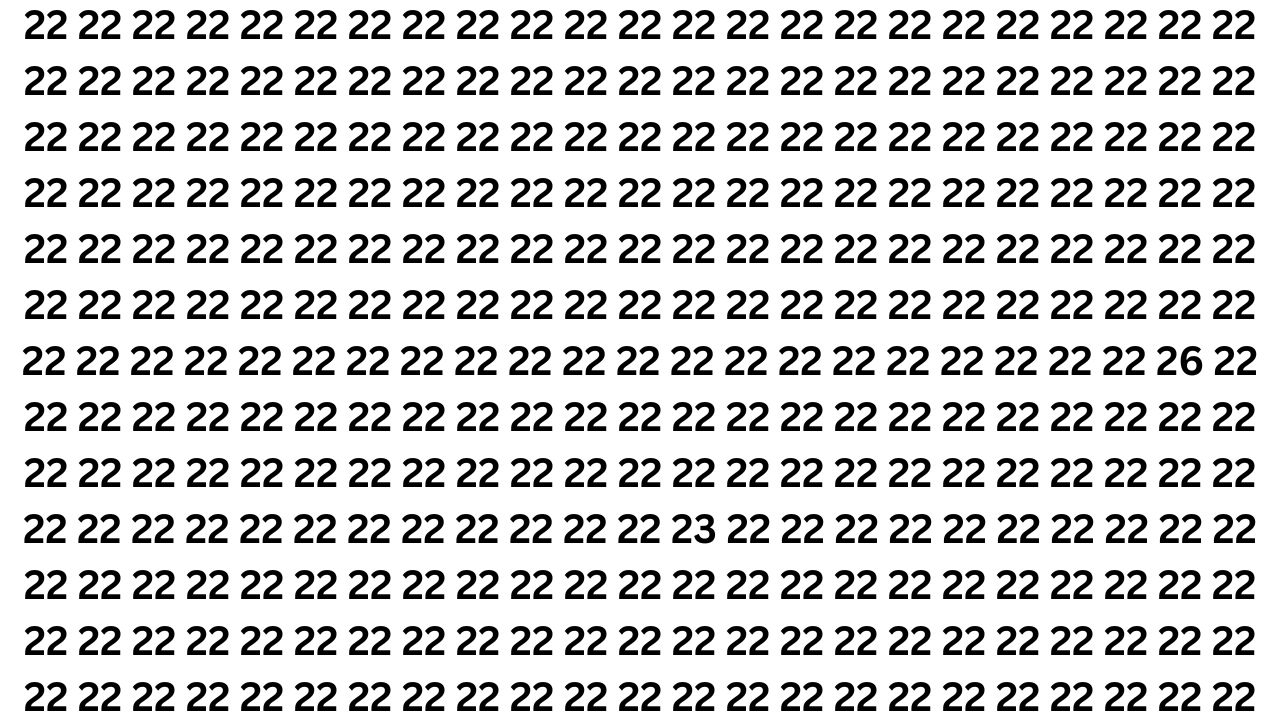
  • Spot 26 and 23 Hidden Among 22 in 9 Seconds

    Spot 26 and 23 Hidden Among 22 in 9 Seconds

    Are you ready to challenge your eyesight and focus? This optical illusion is designed to push your visual skills to the limit by testing how quickly you can spot tiny differences. Your goal is to find the hidden numbers 26 and 23 concealed among dozens of 22s—all within just 9 seconds. At first, the task may seem simple, but the clever placement and camouflage make it far more difficult than expected. The illusion relies on subtle variations that can easily escape notice.

    This challenge goes beyond clear vision. It demands sharp attention to detail, fast thinking, and the ability to filter distractions under time pressure. Ready to put your observation skills to the test? Let’s get started.

    The Visual Test: Find 26 and 23 Within a 9-Second Limit

    Although the grid initially appears straightforward, the strategic positioning of 26 and 23 among the repeated 22s makes this puzzle surprisingly demanding. The illusion is designed to stretch your concentration and visual scanning abilities. With limited time, you must quickly detect two numbers that blend almost perfectly into their surroundings. Only those with exceptional focus and eagle-eyed precision can spot both numbers before time runs out.

    How Optical Illusions Challenge the Human Eye

    Optical illusions are highly effective at testing perception because they exploit how the brain interprets visual patterns. They can cause you to overlook obvious elements or misread familiar shapes. In this puzzle, 26 and 23 are subtly disguised within a uniform field of 22s, requiring both visual sharpness and rapid mental processing to identify the differences.

    Research suggests that engaging with optical illusions can help improve concentration, strengthen visual awareness, and enhance overall brain performance. While this challenge feels like a quick game, it also acts as a mental workout that sharpens your ability to recognize patterns in everyday life.

    Smart Strategies to Tackle the Optical Illusion

    To increase your chances of spotting the hidden numbers, try approaching the challenge with a clear strategy:

    • Focus on Small Differences: Carefully examine each area, watching for slight changes in shape or alignment.
    • Stay Calm Under Pressure: Even with a 9-second limit, controlled focus is more effective than rushing.
    • Search for Visual Outliers: Anything that looks slightly off could reveal the hidden numbers.
    • Use Peripheral Vision: Scanning the grid broadly can help detect subtle inconsistencies.
    • Reset Your View: Taking a brief pause can refresh your perspective and improve accuracy.

    Answer Revealed: The Location of 26 and 23

    Did you manage to find both numbers in time? If yes, well done—your observation skills are strong. If not, don’t be discouraged. This illusion is intentionally challenging, and improvement comes with practice.

    26 appears toward the right side of the image, subtly positioned among the 22s with a slight variation that makes it noticeable upon close inspection.

    23 is hidden near the bottom-left area, blending into the repeated pattern but standing out once you focus on its unique structure.

    Both numbers are deliberately placed to test not only eyesight but also pattern recognition and mental speed.

    Improving Your Observation Skills Over Time

    Puzzles like this optical illusion offer an enjoyable way to build stronger observation habits. Developing the ability to notice small differences can improve focus, problem-solving, and attention in daily activities.

    • Practice Often: Regular exposure to visual puzzles keeps your mind alert.
    • Try Different Illusion Types: Explore number-based, shape-based, and color-based challenges.
    • Balance Speed and Accuracy: Aim to improve reaction time without sacrificing precision.

    Why Optical Illusion Challenges Benefit the Brain

    Beyond entertainment, optical illusions contribute to mental fitness by engaging multiple cognitive skills at once.

    • Sharper Attention to Detail: Frequent practice enhances your ability to notice fine visual cues.
    • Stronger Problem-Solving Skills: These puzzles promote flexible thinking and adaptability.
    • Better Brain Performance: Visual challenges support memory, processing speed, and focus.

    Final Thoughts: Mastering the Art of Observation

    The challenge of finding 26 and 23 among the 22s is an engaging way to test and refine your visual perception. While it may seem difficult at first, consistent practice can significantly enhance your ability to detect subtle details quickly.

    Whether you enjoy puzzles or want to sharpen your mental skills, optical illusions offer a fun and effective solution. Keep training your eagle eyes, and soon you’ll spot hidden details with confidence and speed.

  • Observation Game Challenges Attention by Finding Subtle Differences in Elephant Photos

    Observation Game Challenges Attention by Finding Subtle Differences in Elephant Photos

    If you enjoy puzzles that challenge your thinking and refine visual awareness, the Spot the Difference game is a perfect choice. This engaging activity tests your ability to notice fine details by asking you to spot tiny changes between two images that look nearly identical. Beyond being entertaining, it also serves as a practical way to improve focus and attention span. In this fast-paced brain teaser, you are shown two cute elephant pictures and given just 10 seconds to uncover three hidden differences, combining fun with mental exercise.

    Understanding the Observation Game Concept

    The Spot the Difference format is simple but surprisingly effective. Players see two side-by-side images that appear the same at first glance. With closer inspection, subtle changes begin to emerge, such as missing objects, color variations, or slightly shifted elements. The goal is to find every difference before time runs out, adding excitement and urgency to the experience.

    Most puzzles include a short time limit, sometimes as brief as 10 seconds, encouraging quick thinking and sharp concentration. Over time, these games naturally strengthen attention to detail while offering a light yet stimulating mental workout. They are suitable for all age groups and work equally well for solo play or shared fun.

    Also Read: 8 Yoga Poses to Improve Mental Clarity, Focus, and Emotional Control

    Also Read: 4 Evening Yoga Poses to Release Tight Hips and Reduce Lower-Body Tension

    The Elephant-Themed Spot the Difference Puzzle

    This particular Spot the Difference challenge features two images of a charming elephant. While the pictures look almost identical, three small differences are carefully hidden. Your task is to identify all of them within 10 seconds.

    The real enjoyment comes from examining the finer details. Each difference is subtle and requires focused visual scanning. To play effectively:

    • Study both images side by side.
    • Compare the elephant and the surrounding background closely.
    • Look for objects that may be missing, changed, or repositioned.
    • Try to spot all three differences before time runs out.

    Regularly engaging with this type of puzzle can help strengthen visual awareness, concentration, and memory.

    The Three Hidden Differences Explained

    If you are ready to check your answers, here are the three subtle changes between the elephant images. Missing one or two is common, as the smallest details are often the hardest to notice.

    • Flower Missing From the Tree Stump: In the first image, a small flower appears on the left side of the tree stump, while it is absent in the second image.
    • Butterfly Removed: A butterfly resting on a nearby leaf is visible in the first picture but does not appear in the second.
    • Detail Missing on the Elephant’s Right Foot: A small mark or feature seen on the elephant’s right foot in the first image is missing in the second.

    Each change is minor on its own, but together they put your observation skills to the test, requiring patience and a keen eye.

    Also Read: Simple Morning Hydration Routine That Enhances Skin Glow and Sustains Energy Throughout the Day

    How Spot the Difference Games Support Brain Health

    Beyond simple entertainment, Spot the Difference puzzles offer meaningful mental benefits. They provide a gentle workout that helps keep the brain active and alert.

    • Improves Attention to Detail: Repeatedly searching for small changes trains the brain to notice fine details.
    • Enhances Visual Processing: Careful image comparison strengthens accurate visual interpretation.
    • Boosts Focus and Concentration: Time limits encourage sustained attention and faster decisions.
    • Supports Cognitive Flexibility: Shifting between images improves the ability to change focus smoothly.
    • Encourages Relaxation: Solving puzzles provides a refreshing mental break from daily stress.

    Simple Tips to Spot Differences Faster

    Improving your performance is easier with a few helpful strategies:

    • Scan the entire image first to catch obvious changes.
    • Examine small details like colors, patterns, and tiny objects.
    • Watch for symmetry changes or missing elements.
    • Use visual memory to recall details as you compare images.

    Final Thoughts

    Spot the Difference puzzles, including this elephant-themed challenge, offer a quick and effective way to sharpen observation skills and improve focus. They are easy to play, mentally rewarding, and perfect for a short brain break. Whether you want light entertainment or a focused challenge, these puzzles provide an engaging way to test your attention to detail anytime.

  • Daily Yoga Poses Build Energy Improve Focus and Restore Mental Sharpness

    Daily Yoga Poses Build Energy Improve Focus and Restore Mental Sharpness

    Feeling tired or mentally foggy has become common in today’s screen-heavy routines. When energy dips, many people reach for coffee or sugary snacks, but these quick fixes often lead to crashes later. Yoga offers a steadier and longer-lasting way to support energy levels and sharpen concentration. Through intentional movement, focused breathing, and improved circulation, yoga helps activate both the body and the mind. The six poses below are simple, accessible, and suitable for all levels. Practiced regularly, they can help you feel more alert, centered, and ready for whatever lies ahead.

    How Yoga Naturally Supports Energy and Focus

    Low energy and poor concentration often stem from shallow breathing, tight muscles, and ongoing mental pressure. Yoga addresses these issues together. Gentle stretching improves circulation, allowing more blood to reach the brain. Deep, controlled breathing increases oxygen intake, helping the mind function more clearly. Mindful movement also reduces mental overload and calms stress responses. Unlike intense workouts that may leave you drained, energizing yoga poses awaken the nervous system in a balanced way, leaving you refreshed, focused, and mentally lighter.

    Mountain Pose for Grounded Awareness

    Mountain Pose may look simple, but it is powerful for building body awareness and mental clarity. Stand with your feet hip-width apart, arms resting naturally by your sides, and spine lengthened upward. Balance your weight evenly through both feet while gently engaging your thighs. Roll your shoulders back and down as you lift the crown of your head. Breathe slowly and notice how your body aligns. This pose improves posture, expands breathing capacity, and creates immediate mental steadiness, especially when your thoughts feel scattered.

    Standing Forward Bend to Calm the Mind

    Standing Forward Bend gently energizes the body while quieting mental noise. Begin in Mountain Pose, then hinge forward from your hips, allowing your head and neck to relax. Slightly bend your knees if needed. Let your arms hang freely or hold opposite elbows. This position encourages healthy blood flow to the brain, supporting focus and clarity. It also releases tension in the neck and shoulders, where stress often builds, helping restore both mental and physical ease.

    Warrior Two for Strength and Concentration

    Warrior Two Pose builds stamina while training your ability to stay focused. Step one foot back into a wide stance, bend your front knee, and extend your arms out to each side. Gaze steadily over your front hand, engage your core and legs, and keep your shoulders relaxed. This pose requires both physical effort and mental attention, making it effective for developing confidence and sustained focus. It teaches the mind to stay present, even during challenging moments.

    Chair Pose to Activate Natural Energy

    Chair Pose activates large muscle groups, helping boost energy in a natural way. Stand with your feet together, bend your knees as if sitting back into a chair, and lift your arms overhead. Keep your chest open, core engaged, and breathing steady. This pose strengthens the legs and improves circulation, helping reduce feelings of fatigue. Chair Pose also encourages mental determination and alertness, making it useful before work or study sessions.

    Cobra Pose for Spinal Vitality

    Cobra Pose is a gentle backbend that energizes the spine and opens the chest. Lie face down with your hands under your shoulders. Inhale as you lift your chest while keeping your hips grounded. Draw your shoulders back and look slightly forward. This pose counters poor posture and supports deeper breathing. By stretching the front of the body, Cobra Pose helps ease fatigue and promote alert awareness.

    Tree Pose to Sharpen Balance and Focus

    Tree Pose improves balance and coordination while calming the mind. Stand tall and shift your weight onto one foot. Place the sole of your other foot against your calf or inner thigh. Bring your palms together at your chest or lift them overhead. Fix your gaze on a steady point in front of you. Balance poses demand full attention, helping reduce mental distractions and strengthen concentration and clarity during daily tasks.

    Practicing These Poses for Maximum Benefit

    For best results, practice these poses in a quiet, well-ventilated space. Maintain slow, steady breathing throughout each movement. Holding each pose for five to ten breaths is enough to feel energized without strain. The full sequence takes about fifteen to twenty minutes, making it easy to fit into busy routines. Morning sessions help set a focused tone for the day, while afternoon practice can effectively overcome midday energy dips.

    Creating a Consistent Energy-Boosting Habit

    Consistency matters more than intensity when using yoga to support energy and focus. Short daily sessions can lead to noticeable improvements in how you feel and think. Over time, you may rely less on caffeine as mindful movement keeps you naturally alert. Yoga also helps you recognize early signs of stress, allowing rest before exhaustion sets in. Making these six poses part of your routine supports lasting energy and steady focus, helping you approach daily responsibilities with a calm, clear mindset.

  • Yoga Poses Designed for Better Sleep and Deeper Night Time Relaxation

    Yoga Poses Designed for Better Sleep and Deeper Night Time Relaxation

    A short bedtime yoga routine can gently calm your body and mind when thoughts keep circling or muscles feel tense after a long day. This practice is not designed as a workout. Instead, it serves as a quiet signal that it is time to slow down and prepare for rest. These five beginner-friendly poses do not require flexibility and are most effective when paired with slow breathing in a peaceful environment. Each posture encourages relaxation and helps your body transition smoothly into sleep.

    Creating a Calm Sleep Environment

    Sleep becomes easier when your body feels relaxed and your mind begins to unwind. Gentle yoga before bed helps ease tension in common tight areas such as the hips, shoulders, and back. Slow, steady breathing tells your nervous system that it is safe to rest. Think of this process as gradually dimming the lights on your day. The poses below are intentionally low-effort and comfortable to hold, making them ideal for preparing both your body and mind for deep rest.

    How Gentle Yoga Supports Better Sleep

    Quality sleep improves when the body is no longer holding tension and the mind exits its alert state. Calming yoga poses release tightness in the lower back, hips, neck, and shoulders, while controlled breathing shifts your nervous system toward relaxation. This combination works like turning down background noise after a busy day. Each pose listed below is soothing, requires minimal effort, and can be held longer, allowing your body to fully settle before bedtime.

    Pose 1: Child’s Pose (Balasana)

    Child’s Pose gently relaxes the back and hips while encouraging a sense of safety and calm. Begin by kneeling on the floor and sitting back on your heels. Bring your big toes together and open your knees to a comfortable distance. Slowly fold forward, resting your forehead on the mat or a pillow. Extend your arms forward for a mild stretch, or rest them beside your body if you prefer a more grounded, enclosed feeling.

    Pose 2: Legs Up the Wall (Viparita Karani)

    This posture is especially helpful for tired legs and end-of-day heaviness. Sit sideways next to a wall, then gently swing your legs upward as you lie back. Your hips can rest close to the wall or slightly away. Use a folded blanket under your hips if your lower back needs support. Place your arms on your belly or beside you. Remain here for 3 to 8 minutes. If your mind wanders, softly count your exhales from one to ten and begin again. The simplicity of this focus naturally encourages sleep.

    Pose 3: Reclining Bound Angle (Supta Baddha Konasana)

    This pose opens the hips and relaxes the abdominal area, making it especially comforting after dinner. Lie flat on your back and bring the soles of your feet together, allowing your knees to fall outward. Support each knee with pillows or folded towels to avoid strain. Rest one hand on your chest and the other on your stomach. Hold for 2 to 5 minutes, allowing your belly to rise naturally as you inhale. Keep your jaw and tongue relaxed, as tension in the jaw can keep the body slightly alert.

    Pose 4: Supine Twist (Supta Matsyendrasana)

    A gentle twist can ease lower-back tension and promote relaxation. Begin on your back and draw your knees toward your chest. Let both knees fall to one side while extending your arms out in a T shape. Turn your head in the opposite direction if it feels comfortable, or keep it facing upward. Stay for one to two minutes on each side, breathing deeply into your ribs. If your knees feel unsupported, place a pillow between or beneath them. Comfort is more important than depth.

    Pose 5: Supported Corpse Pose (Savasana)

    Supported Savasana allows your body to fully absorb relaxation. Lie on your back with a pillow under your knees to reduce pressure on the lower back. Cover yourself with a light blanket. If thoughts continue to race, place an eye pillow or soft cloth over your eyes. Remain here for 3 to 10 minutes, breathing in for four counts and out for seven. If needed, shorten the exhale slightly while keeping the breath soft. When finished, roll onto your right side and pause before sitting up.

    A Gentle Bedtime Yoga Sequence

    Practice Child’s Pose for 2 minutes, Legs Up the Wall for 5 minutes, Reclining Bound Angle for 3 minutes, Supine Twist for 2 minutes on each side, and Supported Savasana for 3 to 5 minutes. If time is limited, combining Legs Up the Wall with Supported Savasana alone can significantly calm your body and shift your mood.

    Simple Habits That Improve Sleep Results

    Yoga supports sleep, but timing and environment also matter. Avoid caffeine later in the day if it affects your rest. Dim screens during the last hour before bed and avoid stimulating content. If your mind is busy with tomorrow’s tasks, write a short list and set it aside. Practice nose breathing during your poses and keep your room quiet. Most importantly, stay consistent. Repeating this routine regularly helps your body recognize it as a clear signal that the day has ended.